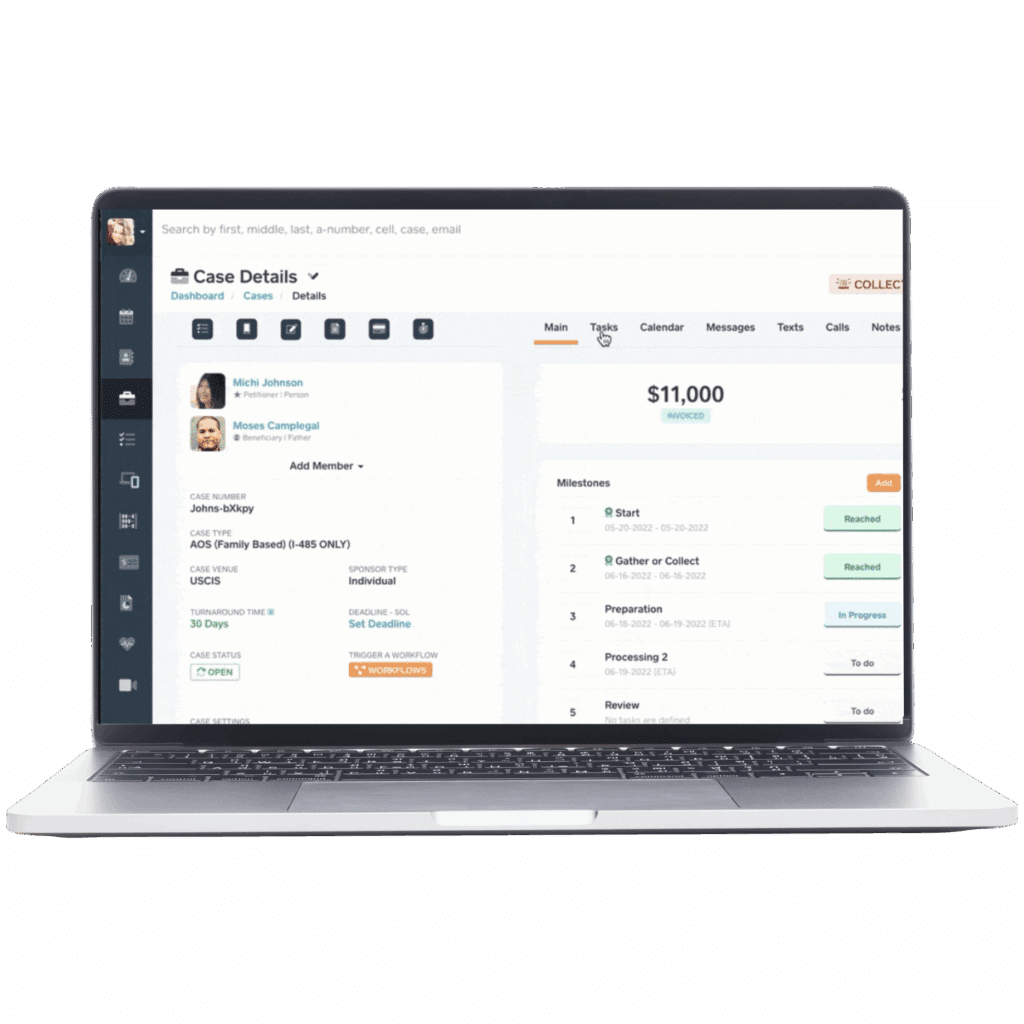

When teams have the right systems, they can focus on what they came to do.
Immigration is not just a legal process. It is a human journey, filled with uncertainty, hope, and a real need for someone in your corner. The organizations that show up for that journey every day are immigration nonprofits and pro bono legal teams working with limited resources, growing caseloads, and the kind of pressure that most workplaces never see.
These teams are doing extraordinary work providing nonprofit immigration services in a tumultuous environment. They help families navigate complicated systems, protect the rights of newcomers, and provide stability during some of the most vulnerable moments in a person’s life. The last thing they need is software that slows them down.
The demand for nonprofit immigration legal services has grown by over 300% in the last decade, while funding and staffing have not kept pace. Source: Migration Policy Institute
The Numbers Behind the Need for Immigration Legal Services
The scale of unmet need in legal services for immigrants is striking.
Over 3.7 million cases are currently pending in U.S. immigration courts, an all-time high. Of those, roughly 2.5 million individuals or about 67% are navigating the system without legal representation, often without any legal training or support.
The consequences of going unrepresented are significant. Among immigrants ordered removed in a recent one-year period, 79% had no legal representation. For children facing deportation proceedings, the number was even starker: more than 70% had no attorney.
Representation changes outcomes. Immigrants with legal counsel attend their court hearings at a 97% rate a figure that underscores how much continuity and support matter in these cases. Yet the share of immigrants in proceedings who have been able to find an attorney has dropped from 65% to just 30% over the past five years.
The gap is not closing on its own. Immigration nonprofits across the country describe themselves as operating well beyond capacity, with cases growing longer and more complicated as a result of ongoing policy changes, making it harder to take on new clients even as demand continues to rise.
This is the environment immigration nonprofits in Washington D.C, Los Angeles, New York, and the rest of the country are working in every day.
The Reality Immigration Nonprofits Face Every Day
There are over 1,000 free or low-cost nonprofit immigration organizations across the United States, according to listings on the Immigration Advocates Network and ImmigrationLawHelp.org. Together, these organizations carry a significant share of the responsibility for guiding individuals and families who often have nowhere else to turn.
High caseloads, rotating staff, and complex legal requirements can stretch these teams incredibly thin. When your day involves back-to-back counseling sessions, urgent document requests, and coordinating with case workers across multiple programs, the administrative side of the work can start to feel like a second full-time job. And when that happens, it is the clients who feel it.
Strong case management is not just a nice-to-have for nonprofits. It is the vital infrastructure that makes the mission possible.
Your work as a nonprofit or pro bono attorney disrupts systemic problems and closes equity gaps in our society. That connection with clients, and the ability to advocate for them fully, depends on having the right operational foundation underneath it.
The Legal Case Management Challenges That Compound Over Time
The pressures facing immigration nonprofits are not new, but they are intensifying. Demand for services continues to climb while funding and staffing largely hold flat. The result is a widening gap between the number of people who need help and the capacity of organizations to reach them.
Several operational realities make this harder:
- Caseload volume. Many nonprofit attorneys and case workers carry far more cases than their counterparts in private practice. Without strong systems, details slip, deadlines get missed, and the quality of representation suffers because of a lack of proper and scalable infrastructure. Centralized case management that surfaces upcoming deadlines and organizes every matter in one place is the difference between staying on top of a heavy caseload and constantly catching up.
- Staff turnover and volunteer coordination. Nonprofits often rely on rotating volunteers, law students, and part-time staff. When institutional knowledge lives in someone’s head or inbox rather than a shared system, every departure creates risk. Platforms that allow teams to assign tasks, share case notes, and track progress in a single location mean a new team member can get up to speed without losing continuity for the client.
- Multilingual service demands. Serving clients in their primary language is essential to informed consent and effective representation. Coordinating multilingual communications, documents, and intake forms without dedicated tools adds significant overhead. Templated multilingual communications and client-facing intake tools reduce the time spent re-creating materials for every new matter.
- USCIS complexity and deadline pressure. Between form submissions, receipt tracking, RFE responses, and biometrics scheduling, the procedural demands of immigration law are relentless. A missed deadline can have serious consequences for a client’s case and legal status. Automated USCIS receipt tracking and deadline reminders move this burden off individual staff members and into the system itself.
- Document management at scale. Immigration cases are document-heavy by nature. Managing client files, government correspondence, and supporting evidence across a high caseload — without a centralized system — is a constant source of inefficiency and risk. Structured document management tied directly to each case record keeps everything findable and audit-ready, without relying on email threads or shared drives.
How Legal Case Management Platforms Can Help
The right tools do not change the complexity of immigration law. What they do is reduce the administrative burden that sits on top of it, so staff can spend more time on the work that actually requires their expertise.
For immigration nonprofits specifically, a well-designed case management platform provides:
01 — Centralized organization from day one One place to manage forms, deadlines, documents, and client notes so nothing gets lost and everyone stays on the same page — regardless of team size or staff turnover.
02 — Automated workflows that reduce manual overhead Automated reminders, reusable templates, and streamlined intake processes help staff spend less time on repetitive administrative tasks and more time supporting clients directly.
03 — Team coordination across roles and schedules Whether an organization has full-time attorneys, part-time caseworkers, or rotating volunteers, shared visibility into case status and task assignments keeps cases moving forward and reduces the risk of things falling through the cracks.
04 — Multilingual communication and intake support Templates and client-facing tools that support multiple languages allow nonprofits to serve diverse communities without creating a separate administrative track for non-English-speaking clients.
05 — USCIS tracking and deadline management Receipt tracking, RFE alerts, and deadline reminders help teams stay ahead of government timelines rather than reacting to them.
Stronger Systems, Stronger Communities
The teams doing this work deserve tools that make things easier, not harder. When demand rises and caseloads get heavier, nonprofits need systems that help them stay organized and reduce stress — without adding to it.
With constrained budgets and an uncertain policy environment, immigration nonprofits will only be able to scale their impact if their operations can scale with them. That means investing in infrastructure that works as hard as the people using it.
Stronger systems lead to stronger nonprofits. And stronger nonprofits lead to stronger communities.
Find out how CampLegal can lighten the administrative load for your nonprofit or pro bono team. camplegal.com/trial/